
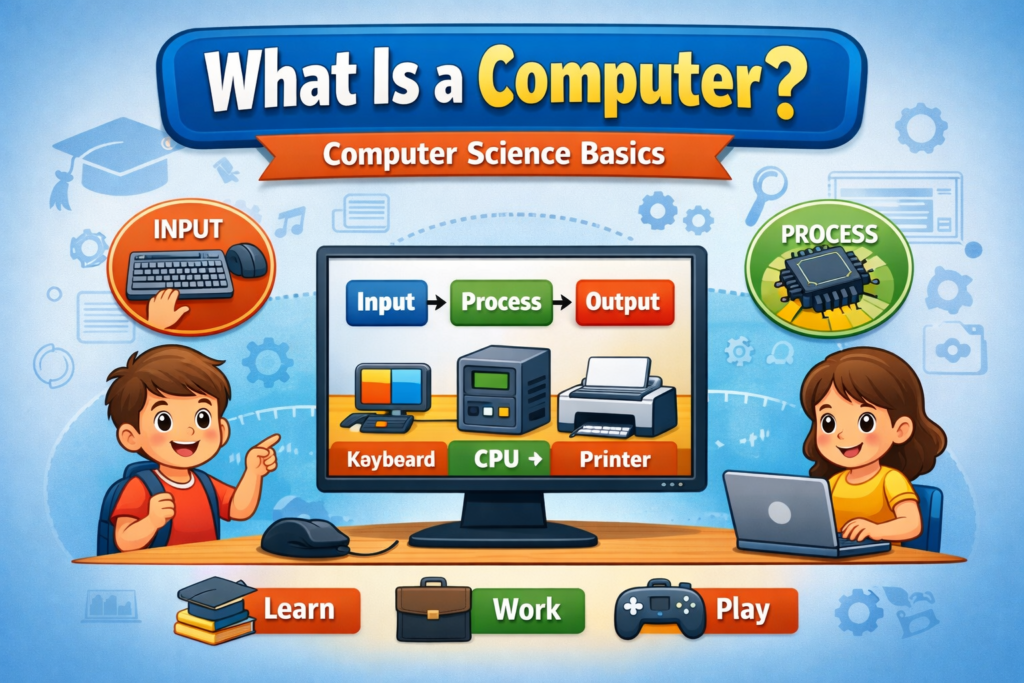
What is a computer and how does it work? Learn the simple definition of a computer, its parts, uses, and examples explained clearly for students from grade 3 to university level.
A computer is one of the most important inventions in modern life. Students use computers for learning, teachers use them for teaching, and professionals use them for work.
But many students still ask a basic question:
What is a computer, and how does it work?
In this article, you will learn the simple definition of a computer, its basic working, parts, and uses, explained in easy language suitable for grade 3 students up to university level.
What Is a Computer? (Simple Definition)
A computer is an electronic machine that takes input, processes data, and produces output according to given instructions.
In simple words:
A computer is a machine that helps us calculate, store information, and solve problems quickly.
What Does a Computer Do?
A computer performs three main tasks:
1. Input
Input means giving data to the computer.
Examples: typing on a keyboard, clicking a mouse, scanning a document.
2. Processing
Processing means working on the data using instructions (programs).
3. Output
Output means the result shown by the computer.
Examples: text on screen, printed paper, sound from speakers.
This cycle is called the IPO Cycle (Input → Process → Output).
How Does a Computer Work? (Student-Friendly)
A computer works in these simple steps:
- It receives data (input)
- It processes the data using CPU
- It stores information if needed
- It gives the final result (output)
Even complex computers follow this same basic principle.
Main Parts of a Computer
A computer system has two major parts:
Hardware
Hardware means the physical parts you can see and touch.
Examples:
- Keyboard
- Mouse
- Monitor
- CPU
- Printer
Software
Software means programs and instructions that tell the computer what to do.
Examples:
- Windows
- MS Word
- Web browsers
- Mobile apps
Uses of a Computer in Daily Life
Computers are used everywhere today:
- Education and online learning
- Offices and business work
- Banking and finance
- Hospitals and medical records
- Communication (email, video calls)
- Entertainment (games, videos, music)
Computer for Different Student Levels
For Primary Students (Grade 3–5)
- Used for basic learning
- Drawing, typing, simple games
For School Students
- Homework and research
- Learning programming basics
For College & University Students
- Programming and projects
- Data analysis and research
- Software development
Is a Computer Intelligent?
No.
A computer does not think on its own.
It only works according to:
- Given instructions
- Programs written by humans
That is why a computer is called a machine, not a human brain.
Types of Computers
There are different types of computers based on size and usage.
👉 Read more here:
Types of Computers
Why Is Learning About Computers Important?
Learning about computers helps students:
- Understand technology
- Improve problem-solving skills
- Prepare for future careers
- Use digital tools responsibly
Computer knowledge is now a basic life skill.
Frequently Asked Questions (FAQs)
What is a computer in simple words?
A computer is an electronic machine that helps us store, calculate, and process information.
Who invented the computer?
Charles Babbage is known as the father of the computer.
Can a computer work without electricity?
No, most computers need electricity or battery power to work.
Is a mobile phone a computer?
Yes, smartphones are also a type of computer because they process data.
Why is computer science important for students?
Computer science teaches logic, problem solving, and technology skills needed in modern life.
Conclusion
A computer is a powerful electronic machine that helps humans perform tasks faster and more accurately. From simple calculations to complex scientific research, computers play a vital role in every field.
Understanding what a computer is forms the foundation of computer science basics, making it an essential topic for students at all levels.
Learning computers today means preparing for a smarter future
Pingback: Types of Computer Explained for Students – Complete Computer Science Guide
Pingback: Networking Fundamentals Explained: A Complete Beginner’s Guide to Computer Networks - Learn Computer Science Step by Step – From School to University