
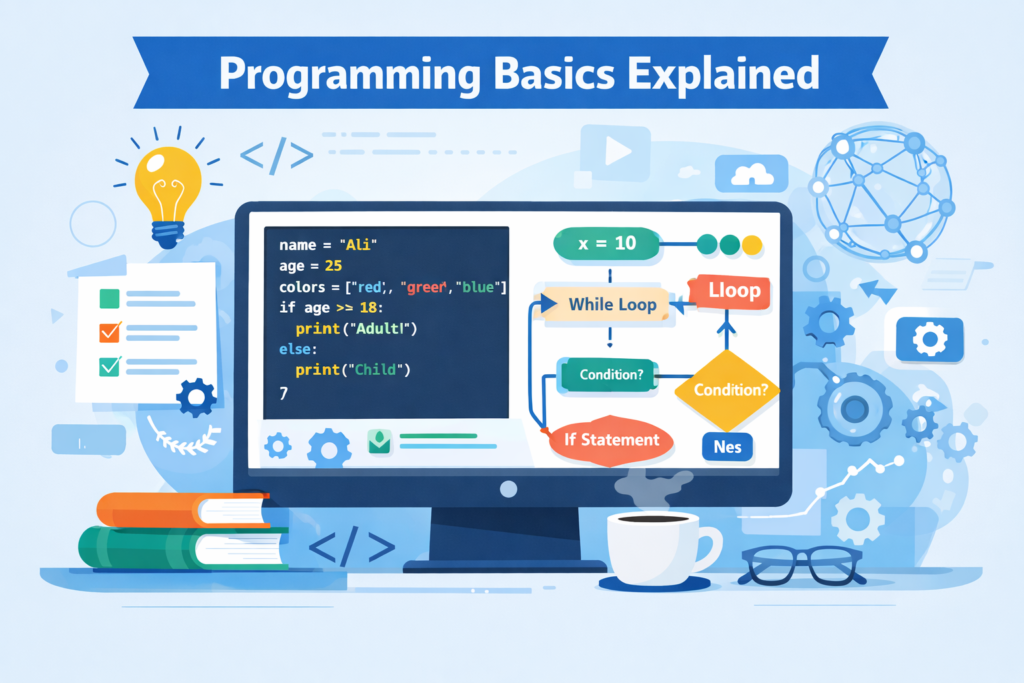
Programming basics explained in simple terms. Learn core concepts, examples, and how beginners can start programming step by step.
Programming basics include understanding how computers follow instructions using logic, variables, conditions, and programming languages. Mastering these fundamentals is the first step toward building software, websites, and applications.
Learning programming starts with understanding its basics. Many beginners struggle not because programming is difficult, but because core concepts are not explained clearly. Once you understand how programming works at a fundamental level, advanced topics become much easier to learn.
This article explains programming basics step by step, using simple language, real-world examples, and practical explanations. It is designed for beginners, students, and self-learners who want a strong foundation before moving to advanced programming.
What Are Programming Basics?
Programming basics are the fundamental concepts used to write instructions for a computer.
These basics help computers:
- Understand commands
- Make decisions
- Store and process data
- Repeat tasks efficiently
Without learning programming fundamentals, writing correct and efficient code becomes difficult.
How Programming Logic Works
Programming logic is the backbone of all software.
At a basic level, computers work using:
- Input – data given to the program
- Processing – logic applied to the data
- Output – final result
For example:
- Input: Numbers entered in a calculator
- Processing: Mathematical operations
- Output: The calculated result
This simple logic applies to every program, from mobile apps to complex systems.
What Is a Programming Language?
A programming language is a structured way to communicate with a computer.
Programming languages allow humans to:
- Write instructions clearly
- Control program behavior
- Interact with hardware and software
Popular beginner-friendly languages include:
- Python
- JavaScript
- C
- Java
Each language follows rules called syntax, which must be written correctly for the program to work.
Variables Explained in Programming Basics
Variables are used to store information in a program.
A variable:
- Holds data such as numbers or text
- Can change during program execution
- Makes programs flexible
Example concept:
- Store a user’s age
- Update a score in a game
- Save a username
Variables are one of the first and most important programming concepts beginners learn.
Data Types in Programming Basics
Data types define the kind of data a variable can store.
Common data types include:
- Integer – whole numbers
- Float – decimal numbers
- String – text
- Boolean – true or false
Using correct data types helps programs run efficiently and avoid errors.
Conditional Statements Explained
Conditional statements allow programs to make decisions.
They help answer questions like:
- If a user is logged in
- If a number is greater than another
- If a condition is true or false
Basic condition logic:
- If condition is true → perform action
- If condition is false → skip or choose another action
This logic is used in login systems, games, and applications.
Loops in Programming Basics
Loops allow a program to repeat tasks automatically.
Instead of writing the same code multiple times, loops:
- Save time
- Reduce errors
- Improve efficiency
Common uses of loops:
- Displaying a list of items
- Running a task multiple times
- Processing large data sets
Loops are essential for scalable and efficient programs.
Functions and Why They Matter
Functions are reusable blocks of code designed to perform a specific task.
Benefits of using functions:
- Code becomes organized
- Repetition is reduced
- Programs are easier to debug
Functions make large programs easier to manage and understand.
Errors and Debugging Basics
Errors are a normal part of programming.
Common beginner errors include:
- Syntax errors
- Logical errors
- Runtime errors
Debugging is the process of:
- Identifying errors
- Understanding why they happen
- Fixing them correctly
Learning debugging improves problem-solving skills and coding confidence.
How Programming Basics Are Used in Real Life
Programming fundamentals power everyday technology.
Examples include:
- Websites and mobile apps
- Banking systems
- Online forms and login systems
- Smart devices
Even advanced technologies rely on the same basic programming principles.
Best Programming Languages for Learning Basics
Some languages are better suited for beginners.
Top choices include:
- Python – simple and readable
- JavaScript – widely used for web development
- C – strong foundation for understanding memory
- Java – structured and widely used
Choosing a beginner-friendly language helps reduce frustration.
How Long Does It Take to Learn Programming Basics?
The timeline depends on consistency and practice.
General learning estimates:
- Understanding basics: 4–8 weeks
- Writing simple programs: 2–3 months
- Building small projects: 3–6 months
Regular practice is more important than speed.
Why Programming Basics Matter for Advanced Learning
Strong fundamentals make advanced topics easier.
Programming basics help with:
- Data structures
- Web development
- App development
- Artificial intelligence
- Software engineering
Skipping basics often leads to confusion later.
read more : what is programming?
FAQs
What are programming basics?
Programming basics are fundamental concepts like variables, data types, conditions, loops, and functions.
Are programming basics hard to learn?
No, they are easy to understand with clear explanations and regular practice.
Which language is best to learn programming basics?
Python is widely recommended for beginners.
Do I need a computer science degree to learn basics?
No, anyone can learn programming basics without a degree.
Can programming basics help with freelancing?
Yes, strong basics are essential for freelancing and remote jobs.
Conclusion
Programming basics are the foundation of every successful programmer’s journey. By understanding core concepts such as variables, logic, conditions, and loops, beginners can confidently move toward building real applications. With patience, practice, and strong fundamentals, programming becomes an achievable and rewarding skill.